
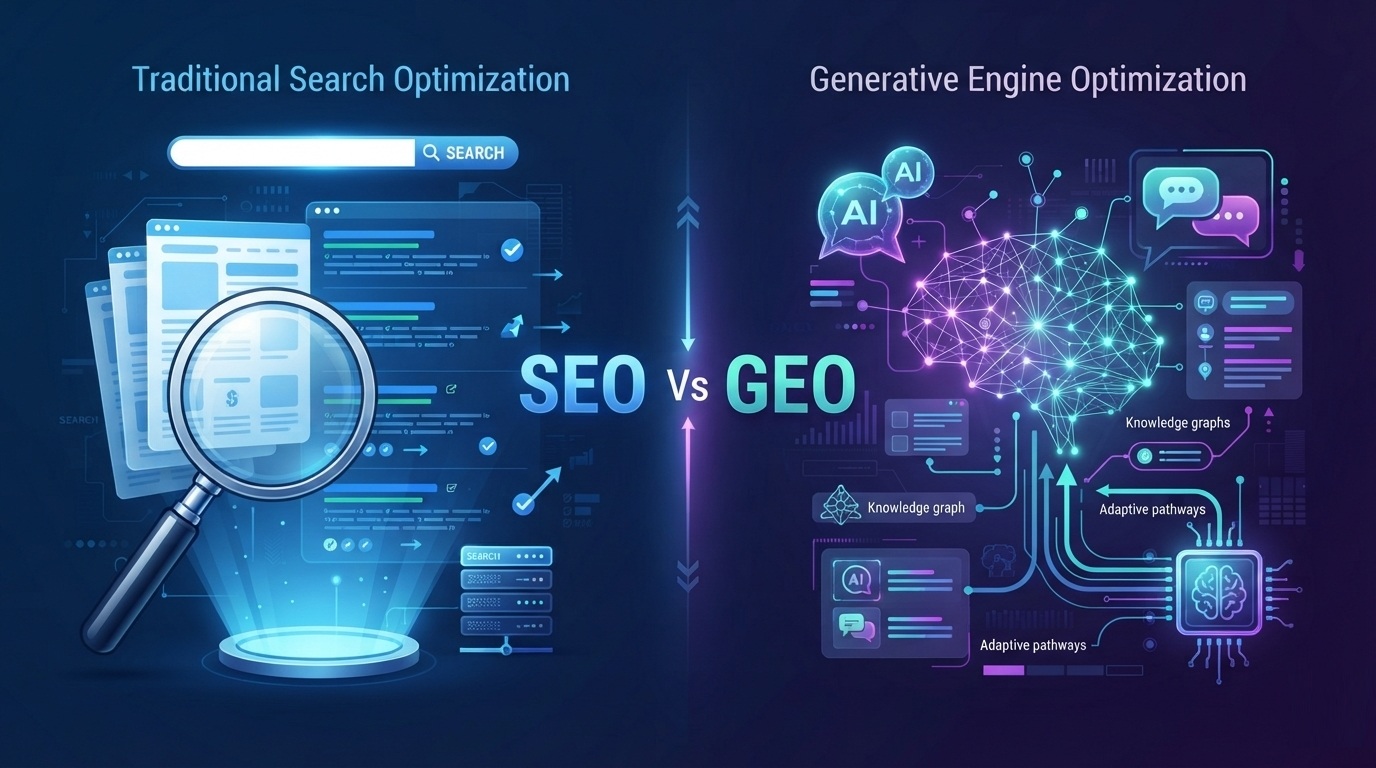
Search engines are changing, and the way customers discover businesses is changing with them. People are no longer relying only on traditional Google search results to find products, compare services or identify the right business. Increasingly, they are asking AI-powered platforms such as ChatGPT and Google AI Search to provide recommendations, explain options, and help them make purchasing decisions.
For businesses, this creates a new opportunity as well as a challenge. Having a website that ranks well on Google is still important, but brands also need to consider how they appear in AI-generated answers.
This is where Generative Engine Optimization (GEO) comes into the picture.
GEO is becoming an important part of modern digital marketing, helping businesses improve their visibility across AI-powered search experiences. In this article, we explore the differences between SEO and GEO, why AI search visibility matters, and what businesses can do to improve their chances of being discovered by potential customers.
What Is Generative Engine Optimization (GEO)?
Generative Engine Optimization (GEO) is the process of improving a brand’s online presence so that its content, services and expertise have a better opportunity to be discovered, referenced or cited by AI-powered search platforms.
Traditional search engines generally present a list of web pages based on a user’s search query. AI-powered search experiences can go a step further by generating conversational answers, summarizing information and providing relevant website references.
For example, a potential customer might ask ChatGPT:
- Which digital marketing agency can help my business generate more leads?
- What is the best CRM solution for a growing company?
- Which cybersecurity services should a small business consider?
- How can I improve my website’s visibility on Google?
Instead of browsing through multiple websites, users may receive a summarized response with relevant businesses, recommendations and source links.
GEO aims to improve the likelihood that your business has a meaningful presence in these discovery experiences.
GEO vs SEO: What Is the Difference?
Search Engine Optimization (SEO) and Generative Engine Optimization (GEO) have different areas of focus, but they are closely connected.
SEO focuses on improving website rankings and organic visibility in traditional search engine results. GEO focuses on improving the chances of your brand and content being represented in AI-generated responses.
Here is a comparison:
| SEO | GEO |
|---|---|
| Focuses on search engine rankings | Focuses on visibility in AI-generated answers |
| Targets keywords and search queries | Targets conversational questions and user intent |
| Improves organic search traffic | Improves AI discovery and brand mentions |
| Focuses on website pages and search results | Focuses on useful information that AI systems can retrieve and reference |
| Measures rankings, clicks and organic traffic | Can include brand mentions, citations and AI referral traffic |
Both approaches are important. GEO should not replace SEO. Instead, businesses should develop a combined strategy that supports traditional search visibility and emerging AI-powered discovery channels.
Why Is AI Search Visibility Important for Businesses in 2026?
The growing adoption of AI-powered search is changing how people research and evaluate businesses.
Google has expanded AI experiences through features such as AI Overviews and AI Mode. ChatGPT also offers web search capabilities that can provide answers with links to relevant sources.
This means businesses have more opportunities to reach potential customers through different online discovery channels.
There are several reasons why AI search visibility deserves attention.
1. Customers Are Changing How They Search
People increasingly use conversational questions instead of searching only with short keywords.
This type of search provides additional context about the user’s requirements. Businesses that publish useful, specific and relevant information have more opportunities to address these questions.
2. Brand Recommendations Can Influence Buying Decisions
AI-generated responses can help users shortlist service providers, compare solutions and understand which businesses may be suitable for their requirements.
If your business is consistently represented through credible information across relevant online sources, it can strengthen brand recognition and help potential customers discover your services.
However, appearing in AI recommendations is not guaranteed, and businesses should not rely on AI visibility as their only source of leads.
3. Traditional SEO Alone May Not Cover Every Discovery Channel
Google rankings remain valuable, but customers can discover businesses through several platforms, including AI search tools, social media, business directories, review platforms and industry publications.
A broader search visibility strategy helps businesses establish a stronger online presence across these channels.
Is your business visible when potential customers ask AI tools for recommendations?
Many businesses invest in website development and traditional SEO without evaluating how their brand appears in AI-powered search experiences.
At Digitroe, we help businesses strengthen their digital presence through SEO, content optimization, and modern search visibility strategies.
Want to understand where your website currently stands? Get in touch with us for a website and search visibility assessment.
Get a callback from our expert team
7 Strategies to Improve Your Website’s Visibility in AI Search
Improving AI search visibility requires more than adding a few keywords to your website. Businesses need to build a reliable online presence, publish useful information and make their website accessible to search systems.
Here are seven practical strategies to consider.
1. Publish Helpful and Informative Website Content
Content remains an important part of both SEO and AI search visibility.
Instead of publishing articles only to target keywords, focus on answering questions that your potential customers are actually asking.
The objective is to provide useful information that demonstrates your business knowledge and addresses genuine customer requirements.
2. Build Authority and Establish Your Brand Online
AI systems may use information from multiple sources to understand businesses, products and services.
Therefore, your brand should have a consistent and credible online presence.
Some activities that can support this include:
- Publishing expert-led articles and industry insights.
- Getting featured on relevant industry websites.
- Building quality back links from authoritative sources.
- Maintaining accurate business directory listings.
- Collecting genuine customer reviews and testimonials.
- Participating in relevant industry discussions.
Building authority is not about getting as many mentions as possible. The relevance, accuracy and credibility of the information matter.
3. Optimize Your Website’s Service Pages
Your service pages should clearly explain what your business offers, who you help and what problems you solve.
Avoid generic descriptions that simply list services without explaining their actual value.
For example, an IT services company should explain its infrastructure management capabilities, supported technologies, business use cases and customer benefits.
A well-structured service page should include:
- A clear service description.
- Problems your service addresses.
- Key features and benefits.
- Relevant implementation processes.
- Frequently asked questions.
- Customer testimonials or case studies, where available.
- Clear enquiry and consultation options.
This makes it easier for visitors to understand your offering and take the next step.
4. Target Conversational and Question-Based Search Queries
People often interact with AI search platforms using complete questions rather than short search terms.
Your content strategy should reflect this behavior.
Create dedicated articles, service explanations and FAQ sections that provide direct, meaningful answers.
Avoid adding questions simply to increase keyword coverage. Each answer should offer genuine value.
5. Strengthen Technical SEO and Website Accessibility
Even high-quality content needs a technically sound website.
Search engines and AI-powered discovery systems need to access and process website information. Technical issues can make this more difficult.
Important areas to review include:
- Website crawlability and indexability.
- XML sitemap configuration.
- Robots.txt settings.
- Website loading speed and mobile usability.
- Internal linking structure.
- HTTPS implementation.
- Structured data and schema markup.
- Accessible and readable website content.
For ChatGPT search visibility, website owners should also check that OpenAI’s OAI-SearchBot is not unintentionally blocked by their robots.txt file or hosting infrastructure.
Technical accessibility does not guarantee AI citations or recommendations, but it helps ensure that your website can be discovered and processed.
6. Use Structured Data Where Relevant
Structured data helps search engines understand specific information about your website and its content.
Depending on your business and website, relevant schema types may include:
- Organization schema.
- LocalBusiness schema.
- Service schema.
- Article schema.
- Product schema.
- BreadcrumbList schema.
Ensure that the structured data accurately reflects the information displayed on your website.
It is important to understand that schema markup does not guarantee AI recommendations or special search visibility. It should support a technically well-organized website rather than be treated as a shortcut to rankings.
7. Monitor Your Brand’s Visibility Across AI Platforms
Businesses should start evaluating how their brands appear across different search and AI platforms.
You can begin by testing relevant questions on ChatGPT and other AI-powered search experiences.
Observe whether your brand appears, which competitors are mentioned and what information is being used to describe your business.
You can also monitor referral traffic from AI platforms, website engagement, branded search trends and relevant search performance data.
AI-generated responses can vary between queries and over time, so a single search should not be treated as a reliable measure of overall visibility.
Common GEO Mistakes Businesses Should Avoid
As interest in GEO increases, many businesses are experimenting with different optimization techniques. However, not every popular recommendation delivers meaningful results.
Avoid these common mistakes:
1. Ignoring traditional SEO: GEO is not a replacement for SEO. Technical optimization, content quality, indexing and website authority remain important.
2. Publishing large volumes of generic AI-generated content: Content created only to increase page count without adding original value is unlikely to build lasting credibility.
3. Overusing keywords: Repeating the same search terms unnaturally can reduce content quality and make pages difficult to read.
4. Buying irrelevant back links and brand mentions: Focus on genuine, relevant and trustworthy sources instead of artificial link-building schemes.
5. Expecting guaranteed AI recommendations: No agency can legitimately guarantee that a business will be recommended by ChatGPT or cited in every AI-generated answer.
A sustainable strategy should prioritize useful content, technical quality, brand credibility and measurable business outcomes.
How Can Digitroe Help Your Business Improve AI Search Visibility?
As search behaviour evolves, businesses need a digital marketing strategy that goes beyond traditional keyword rankings.
At Digitroe, we believe that improving online visibility requires a combination of technical SEO, content development, brand authority and conversion-focused website optimization.
Our SEO and GEO-focused approach can help businesses work towards:
- Improving website discoverability across search platforms.
- Building relevant and authoritative website content.
- Optimizing service pages for customer search intent.
- Strengthening technical SEO and website performance.
- Developing quality back links and brand mentions.
- Evaluating visibility across AI-powered search platforms.
- Converting relevant website visitors into business enquiries.
Whether you are a startup looking to establish your online presence or an established business aiming to improve search visibility, having the right optimization strategy can make a difference.
Ready to make your business more discoverable online?
Don’t wait until your competitors establish a stronger presence across AI search platforms.
Contact Digitroe today to discuss your SEO and GEO strategy. Let’s work towards making your business easier to discover, trust and choose.
Frequently Asked Questions (FAQs)
1. What is GEO in digital marketing?
Generative Engine Optimization (GEO) is an approach to improving a brand’s visibility in AI-generated search responses. It involves creating useful content, establishing brand authority and ensuring that website information can be discovered and understood by AI-powered search platforms.
2. Is GEO replacing traditional SEO?
No. GEO complements traditional SEO rather than replacing it. Technical SEO, quality content, website structure and authority remain important foundations for visibility across both traditional and AI-powered search experiences.
3. How can my business appear in ChatGPT search results?
Start by ensuring your website is publicly accessible and that OAI-SearchBot is not blocked. Publish useful, accurate content, build a credible online presence and maintain technically sound website pages. However, appearing in ChatGPT search results is not guaranteed.
4. How long does it take to see results from GEO?
There is no fixed timeline for GEO results. Visibility depends on factors such as website accessibility, content quality, brand authority, competition and how AI platforms retrieve information. Businesses should approach GEO as a long-term digital visibility strategy.
5. Does my business need both SEO and GEO?
Yes, adopting both approaches can help businesses address different customer discovery behaviours. SEO supports organic search visibility, while GEO focuses on visibility within AI-generated responses. A combined strategy can help businesses reach potential customers across multiple discovery channels.
6. Can GEO help generate business leads?
GEO can contribute to brand discovery and referral traffic when your business is surfaced in relevant AI responses. However, generating inquiries also depends on your website experience, service positioning, pricing, credibility and calls to action.
Looking to improve your website’s visibility in Google and AI search?
Talk to Us
Digitroe – Helping Businesses Grow Through Digital Innovation.
